LEARNING MACHINES x Rémy BOCQUILLON
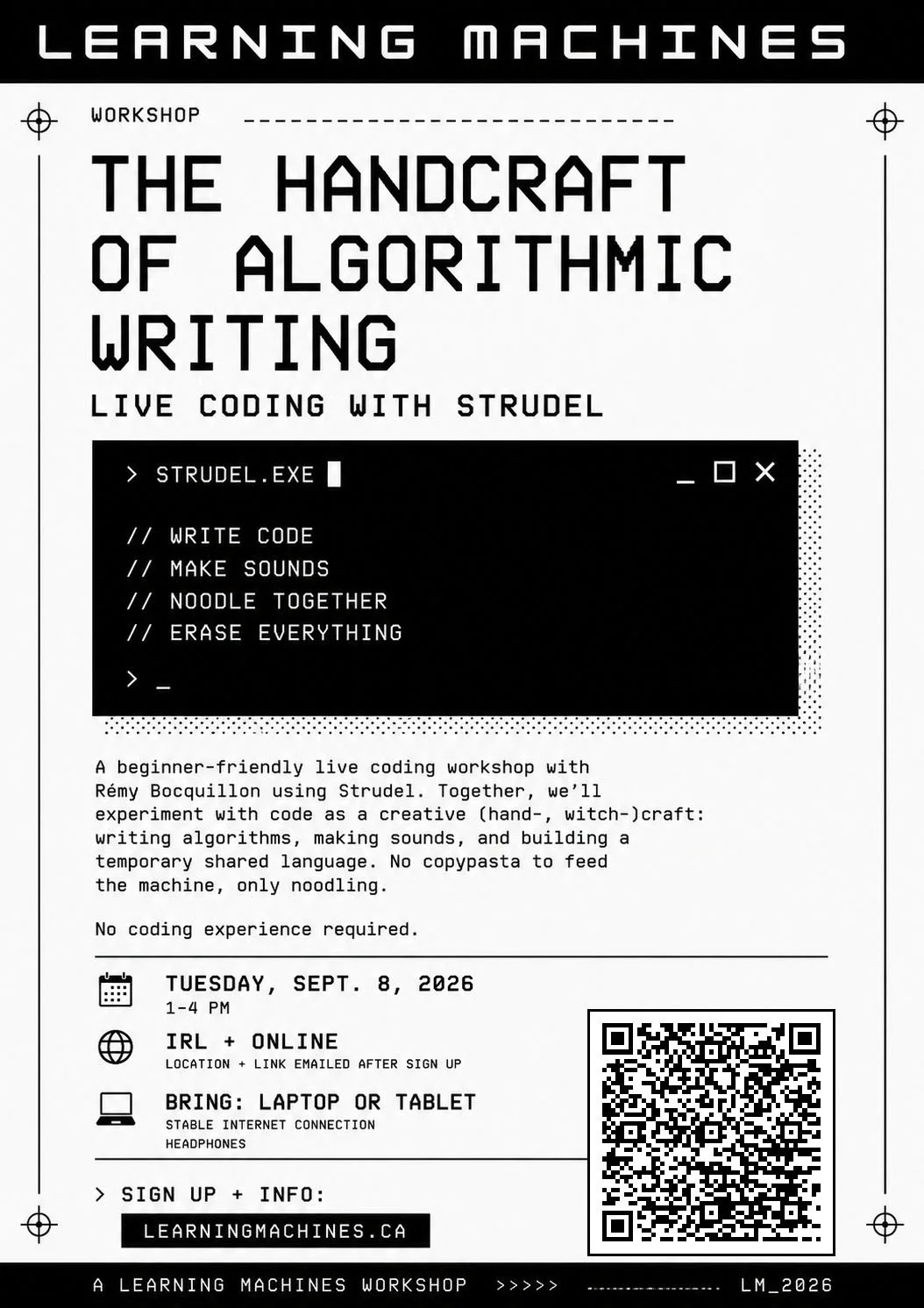
The Handcraft of Algorithmic Writing — Live Coding with Strudel
Tuesday, September 8, 2026; 1–4 PM; In Person + Online
This workshop offered an introductory encounter with the live coding music environment called *Strudel*, a web-based app made to live code music—to write and execute code “on the fly,” in “real time”—based on the popular JavaScript language (see https://strudel.cc/).
However, more than just an introduction to writing a beat or a melody, the workshop focused on live coding as a creative practice and mode of experimentation. As (so-called) artificial intelligence relentlessly rewrites cultural practices, particularly those related to code and algorithmic writing, this workshop proposes that live coding can be understood as a (hand-, witch-)craft rather than simply a technical operation oriented toward productivity, commodification, and automation. Can “coding” generate (algo-)rhythms rather than just “vibes”? What happens to our relations with computers when code is handcrafted rather than generated for us? Can live coding become a performative practice for composing iterative yet fragile machinic assemblages?
With a limited set of functions and a small collection of recorded and found sounds, participants collectively created a shared new language that lasted only for the duration of this experiment. Code was “handcrafted,” “hand written.” No copypasta to feed the machine, only noodling! As a closing movement in this communal sound ritual and an homage to variants of the infamous “pastagang” (an open live-coding jam where everybody can join: https://pastagang.cc), the code of the performance was then wiped out, completely erased from the screen, leaving only a blank page.
Participants did not need any prior coding experience, with either Strudel or another programming language. This was a beginner-friendly workshop.
Dr. Rémy Bocquillon is a researcher and lecturer in sociology at the Catholic University Eichstätt-Ingolstadt, Germany. His research focuses on the possible combinations of sonic (aesthetic) practices and scientific research, mostly (but not exclusively) within sociology and asks how knowledge can be produced with sound, a thinking-with sound. He also like to play with sounds on computers and instruments.